Book Review: 'Am I Normal?' - Dr Alex George
Rating: ★ ★ ★ ★ ★
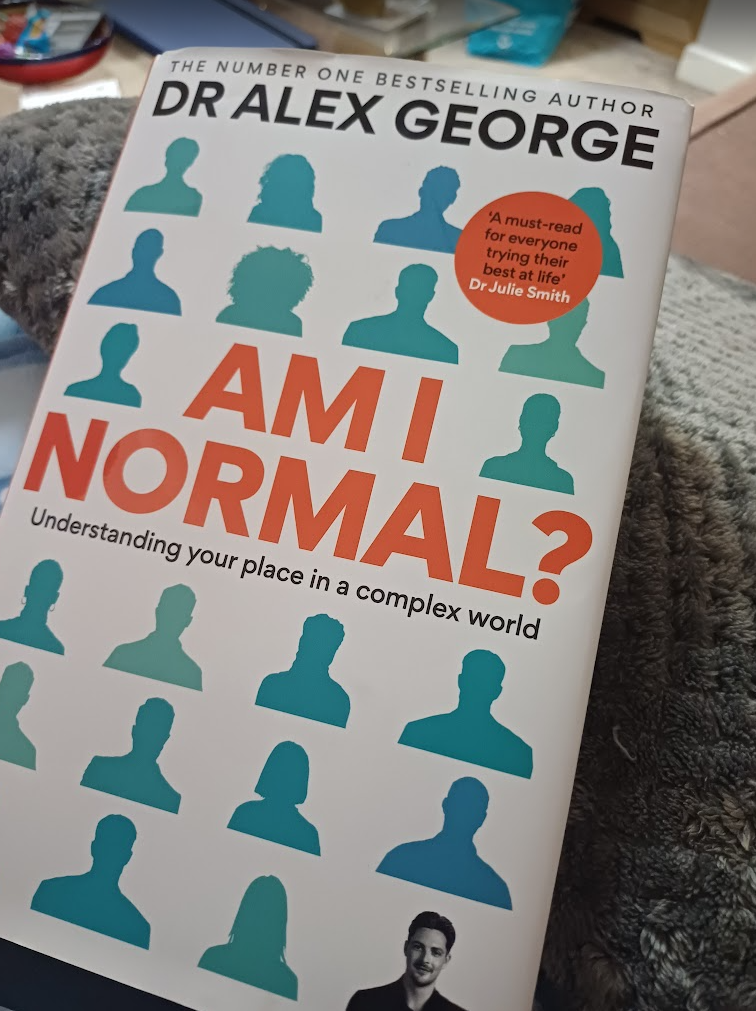
“Am I Normal?” is probably a question many of us have asked ourselves at various points in our lives. Personally, experiences of mental and physical health throughout my life and my childhood have led me to ask this question on more than one occasion. As somebody who struggles to do tasks such as opening a baked bean tin, tying my shoelaces, riding a bike and using scissors, the question of ‘Am I Normal?’ has consistently ran through my head. What is wrong with me, why can’t I do things that other people can do and am I normal has repeated in my brain on a constant loop.
Instagram is a platform utilised by individuals to look for content around mental wellbeing and mental health. Dr Alex George, originally known for appearing on Love Island, is a doctor and mental health advocate who uses social media and podcasts to advocate for mental health support. His work with YoungMinds as a mental health youth ambassador is particularly inspiring. When scrolling through Instagram, Alex’s content and promotion of the book ‘Am I Normal?’ immediately stood out to me, as the questions that had plagued me linked to the book title. Without a second thought, the doomscrolling on Instagram was over, the Amazon app was opened, and the book was on the way. The following day, the book arrived and this was one of those ‘start now’ type of books.
‘Am I Normal?’ differs to self-help mental health manuals, as the book dives deep into exploration of topics such as mental health, ADHD, OCD, grief, alcohol dependency, friendships, education and work. Alex George explores the concept of what it means to be normal on the outside, when navigating a people-facing job, when on the inside he does not feel normal. Alex speaks openly about the struggles he faced growing up, navigating friendships and a society where he did not feel accepted. He also talks about his experiences in adulthood, working as a doctor, being diagnosed with ADHD and OCD, as well as his relationship with alcohol and the grief of losing his brother during the pandemic. Alex discusses his experiences alongside speaking openly about self-compassion, medication, therapy, how his dog Rolo has helped him and how sleep, sobriety and a good diet has improved his lifestyle. The chapters were structured perfectly, allowing for the book to be completed at a fast pace, whilst allowing the reader to gain understanding of the complexities of life. As a reader, the reflections, emotions and journey Alex took me on helped me consider and reflect on my own experiences, including considering how the techniques suggested by Alex could be implemented into my own life. The book was truly life-changing, healing, emotional and captivating. The question of ‘Am I Normal?’ was spinning in my head less and less, as Alex allowed development of self-compassion and an understanding of myself, my vulnerabilities and my past and future life experiences.
A particular section of the book which healed me was the honesty and rawness Alex expressed over his change in educational path. Alex spoke about his original rejection from medical school, which led to a different university, which suited his learning styles and life. Alex discusses how the education system is not sustainable for individuals with poor mental health and neurodivergent identities, through rigorous examinations and a classroom set up which does not allow individuals to flourish. The education system is designed to suit a neurotypical brain, which Alex critiques due to his own experiences of ADHD growing up. The path that Alex took to become a doctor involved attending a university which better suited his learning style. This felt extremely relatable, due to my current attendance at University Centre Peterborough, (UCP), which is a smaller institution which prioritises student support, mental wellbeing and individualised support with smaller class sizes. This has been an ideal environment for me, which has allowed confidence, resilience and my academic style to flourish alongside a close-knit group of peers, which differs to my experience in previous secondary education. Initially, the goal was to attend a larger university with limited support and larger class sizes, which would not have benefited my life and academic voice. Like Alex, education took a different direction which allows me to express gratitude that life worked out this way.
‘Am I Normal?’ dismantles the societal expectation of “normal” and encourages diversity, difference and acceptance for people, like me, who question ourselves and our ability to do things. It reminds us that difference, understanding and compassion encourages us to be our best selves and who we really are, without masking true identities. Alex encourages readers to “take pride in abnormality. Seek it and grow into it” which is advice I will take into my own life. It also encourages individuals to “help someone else be authentically abnormal.” It calls on society to be more understanding and compassionate to individuals who experience mental health, alcohol addiction and/or identify as neurodivergent. A quote from Alex’s book suggests how society should change – “which brings us to the end of my first answer to the question ‘Am I Normal?’, which is ‘No, and if we saw that as less of a problem, we would all be better off.” Alex’s book has allowed me to consider how society perpetuates “problematic norms” as Alex discusses, such as a lack of understanding of neurodiversity which presents itself in our work and education system. Hopefully, the book will encourage and inspire individuals to advocate for social change and advocate for themselves – as it has done for me.


Comments